Monday, June 14, 2010

President William Taft Speaks in Springfield's Court Square


Running for the Republican nomination and ultimately re-election as United States President, incumbent William Howard Taft visited Springfield during the height of a contentious primary campaign waged against his political rival, Theodore Roosevelt, giving a speech at Court Square on April 25, 1912, before a crowd of 20,000.

Taft went on to win the nomination, spurring Roosevelt (who had already served as President for the 7 1/2 years prior to Taft) to form the Progressive Party. The Republican Party thus split resulted in the first election of a Democrat, Woodrow Wilson, to the highest elected office in the land in 20 years.


Photo source: Library of Congress; American Memory Collection; http://memory.loc.gov/cgi-bin/query/r?pp/ils:@filreq(@field(NUMBER+@band(ggbain+11216))+@field(COLLID+ggbain)); Believed taken April 25, 1912 (possible alternate date: 1909).


Home|Welcome|Table of Contents|Explore|Upcoming Events|Patrons|Marketplace|Contact|Privacy

Sunday, April 25, 2010

Tekoa Reservoir, Montgomery, Massachusetts


Although the image preserved in this postcard from 1939 or later is captioned "Montgomery Reservoir, Westfield, Mass.," the scene is actually the dam and head works of  Tekoa Reservoir in the neighboring town of Montgomery.  Montgomery Reservoir (as it's known to Westfield residents, if you're from Montgomery, it's Westfield Reservoir) is a couple of miles north up Moose Meadow Brook from its smaller counterpart.

The two Westfield water storage areas were built in 1874 following that city's successful statehouse request to acquire land in the town of Montgomery for the purpose of providing its residents with a steady supply of the life-sustaining natural resource. The 1873 act of of the Massachusetts Legislature resulted in the taking of nearly five square miles of property along and around Moose Meadow Brook to form the watershed of the Montgomery Supply System.

Businesses displaced that had utilized the brook as a source of power included saw and grist mills. Moore's whip factory was forced to close, the family later establishing the Mountain House north of the upper reservoir, an inn that specialized in serving up the fresh air of Montgomery country summers to its guests.


The head works is now missing atop the dam at Tekoa Reservoir and trees have risen along the banks of Moose Meadow Brook as seen in this 2010 spring season photograph.

Chauncey D. Allen was in charge of the major public works project, which carried a price tag of a hefty quarter of a million dollars. Allen lived in Westfield, in a house built on the lot General William Shepard's home once occupied on Franklin Street. He also owned the 10 acres between King, Smith and Grant Streets. This land later became a park named in his honor, bequeathed to the city in 1929 by Allen's son-in-law, Albert E. Steiger, the beautiful Grandmothers' Garden part of its grounds.

Two dams were built on Moose Meadow Brook under Allen's direction. An earthen dam located on the upper part of the brook held back the 38 surface acre, 125 million gallon capacity Montgomery Reservoir. Downstream, the brook was dammed with stone, creating Tekoa Reservoir, an acre and a quarter of water surface area with a capacity of nearly 4 million gallons.

Montgomery Reservoir was built as a storage reservoir and according to the Westfield Water Department's web site, has a modern-day capacity of 184 million gallons.

The reservoir was taken off-line in 1974 because of water purity issues. A step Chauncey failed to take when he built the Montgomery Reservoir was to scoop away the earth to the bedrock below the area to be flooded, an oversight which later came back to haunt the city with tap water that was unpleasant to the senses of taste, smell and sight.

Tekoa Reservoir once served the purpose of a diversion reservoir, the head works atop its stalwart stone structure controlling the gravitational flow of Moose Meadow Brook, dropping 480 feet in altitude on its roiling, two-plus mile journey southward between reservoirs. A 14 inch main at the base of the dam supplied a reliable stream of water to Westfield's center, over four miles away.

Today, the Montgomery Reservoir is maintained solely as an emergency supply and was most recently used as a water source for helicopters fighting a mid-April, 2010, wild fire on Russell's Tekoa Mountain that scorched hundreds of acres.

For more on Tekoa Mountain, including photographs from up top, check out the EWM post The View From Tekoa Mountain, Russell, Massachusetts.

As always, thanks for stopping by and take care.


More info:

Excellent Westfield Water Department history from the official city web site:

http://www.cityofwestfield.org/detpages/departments329.html


Chauncey Allen Park & Grandmothers' Garden history from the folks who support them:

http://www.grandmothersgarden.org/history.htm


For amazing photographs of Grandmothers' Garden:

http://lizziebelle.blogspot.com/


To get to Tekoa Reservoir (and some great hiking!):


View Larger Map


Home|Welcome|Table of Contents|Explore|Upcoming Events|Patrons|Marketplace|Contact|Privacy

Sunday, April 18, 2010

The Second Annual International Bicycle Club Meet at Hampden Park, Springfield, Mass.


The Springfield Bicycle Club, organized on May 6, 1881, hosted the second annual International Bicycle Meet in the city's Hampden Park over the three days of September 18, 19 and 20, 1883.

Although the meet held the previous September had garnered a respectable interest, drawing a crowd of 12,000 participants and viewers, the second surpassed all attendance figures of the first and, for a time, held the record for highest attendance of such an event nationwide.

Perched along the east bank of the Connecticut River a bit south of the North End bridge, well-groomed Hampden Park was highly-regarded as one of the finest such venues in the country, with a half-mile bicycle track, a one-mile trotting track and a base ball diamond as well as easy access to transportation and city amenities.

The Milton Bradley Company was responsible for the fine lithography of this colorful moment captured in time.

As always, thanks for stopping by and take care.


Image source: Library of Congress; American Memory Collection; http://memory.loc.gov/cgi-bin/query/r?pp/ils:@filreq(@field(NUMBER+@band(cph+3a50896))+@field(COLLID+pga))


Home|Welcome|Table of Contents|Explore|Upcoming Events|Patrons|Marketplace|Contact|Privacy

Tuesday, April 6, 2010

The Keystone Arch Bridges Trail: Magic in the Berkshire Mountains

In a patch of forest in the Berkshire Hilltowns of Chester, Becket and Middlefield, monoliths loom: Monuments of mechanical magic, spans of spatial interpretation, stone apparitions framed in thick-treed horizons growing from gorge walls and fording a wild, steady cascade. Visionary bridges to the tomorrow of yesterday.


A walk along the Keystone Arch Bridges Trail brings a body back to a time when dreams were coming true, as the push over and through the forbidding mountain margin of Western Massachusetts taunted engineers with its impossibilities. Surmounting the granite bounds of earth raised skyward proved a test of ingenuity ne'er faced before by the architects of human expansion. In 1841, the task was met.


Cutting through the hillside, spring streams swollen with winter run-off follow the path of least resistance to the Westfield River's West Branch, the water barrier that the Keystone Arch Bridges of the Western Railroad tamed as the drive to reach the Hudson River in New York and commerce to the west reached its 19th century crescendo.


Mimicking the track of the West Branch Gorge through torturous terrain was sensible to railroad surveyor, Major George W. Whistler, its climb in altitude lower and less of a grade than hopping mountains, but it wasn't easy. Ten keystone arch bridges were required to stitch the winding slash of cold-running rapids together 'neath silver rails of American steel.


Along the trail, Chester Blue granite smoothed and shaped by human hands and machines rounding rock, shining stone to gleam; broken pieces, rejects from the quarry now shoring up roadside embankments: No less important a task than their cemetery silent siblings or Main Street curbstone cousins. The fallible human animal in nature displayed.


Modern-time, scrap-booked structures stand abandoned in tangled trees, faded Posted signs warning the curious away, a worn path outward and onward testament to bold-lettered ineffectiveness. 'Tis important to respect the rights of others while expecting your own are cherished. The tower through the woods once held a clock that ticked a creative countdown for the residents of this one-time artists colony, built in 1961 and now but a memory and a magnet.


Humans and stone are silent partners in time, measured in mossy patina.


Roadside, four granite posts once linked with plank, chain or bar, squared no longer; pondered by passerby who see perhaps funeral plots or animal enclosures or just four stones set in the earth, mum witnesses to history.


Usually it isn't until the dwelling is gone, evidence of life left behind in stone and scrap, that we wonder: What happened here? The question raises new walls atop sill plates of the past, ghosts hidden within.


From carved granite to molded recycled resin, the ages sport a chronology of divergent materials used for bridging gaps along the path of humanity, terrain-crossing advancements made with one purpose in mind: To advance.


And, beneath the span, the water drops, the wind whips and the earth moves, delineating still and forever borders of embankments tracing deep wrinkles in the earth. It is all - everything under the sun - eroded, erosion...eroding.


A well-marked trail lovingly brought to life and maintained by the Friends of the Keystone Arches, the walk is by no means casual, nor is it too taxing; but it is interesting, every step of the way.


The passing breeze of  Pontoosic Turnpike travelers surely swept the exterior of the structure that sat upon this foundation situated along the Pittsfield to Springfield road's north side. Ah...for the illuminating flash of one day a century old spent looking out a window here...


In the distance, camouflaged with initial disbelief, six stories of stacked stone rise from the earth in graceful granite elegance, the stalwart statue sharp contrast to the roiling, boiling wildness of the Westfield River's western arm.


Across the river and along the trail, the still-active CSX railroad tracks dart in and out of view, underlining the timbered horizon. Their trajectory through the Berkshire hills was redirected in 1912, for efficiency's sake, bypassing and rendering inactive the two massive spans enjoyed and explored today by visitors to the Keystone Arch Bridges Trail.


One-thousand men, most of them new to America, achieved what naysayers doubted could be done, building the world's highest railroad at the time. The Western Railroad traversed forbidding, remote terrain in a transportation engineering feat never before attempted. With each train rumbling through its carved mountain passages, it remains a testament to the human competitive spirit, both witness and participant to a fledgling nation's history.


Shards of crockery, rounded stones, new dead branches deposited atop centuries of silt; washed over with the passage of time and the changing of the sky.


Because of its isolated locale, naturally occurring elements were the preferred construction material for this arm of the Boston - Albany link. To the delight of builders - and the disdain of farmers - granite is found in great abundance here in Western Massachusetts. Still, each carved stone had to travel from the Chester Granite Works quite a distance away before it found its home for the ages.


Beautiful simplicity, one advantage to mortar-less construction is porosity and the ability to shed water through nooks and crannies, preventing ice build-up in brutal Berkshire winters and the frost-heave side-effects of the thaws and refreezes of unpredictable Berkshire springs.


A significant rock slide across the old rail bed illustrates the perils of mountain travel.


Brute force and hard labor conquered formidable walls faced by the men charged with the task of chasing the setting sun with ribbons of rail and the consumers who lived in its stead. Black powder explosions threw shards of rock skyward, each blast a step closer to the goal: Get to the other side...on to the next obstacle, each achievement a blaze on the trail westward. Expansion at the point of a pick-axe, grim determination to succeed in each shovelful of stone.


Spring comes just a bit later to the Hilltowns of Western Massachusetts...


One of a pair of old train signal marker bases that straddle the trail along the section of rail bed that went dormant in 1912, the unquestioned power to control movement faded into an anonymous concrete anomaly.


Keystone arch bridges weren't the only structures utilized to facilitate Berkshire Range rail travel, this giant, curved granite retaining wall an example of the nearly twenty other necessary engineered enhancements to the rugged landscape along the circuitous mountain leg of the Western Railroad.


Seventy soaring feet high above the river, passengers and freight moved east and west in a sweeping dance of daily destinations met per schedule, station platforms left with a puff of smoke behind for the next stop on the journey; each ticket, each package, a story waiting to be told.


A piece of coal spared the tender's fire.


'Tis a fair thing to say that the geographical confluence of Chester, Becket and Middlefield as experienced along the Keystone Arch Bridges Trail holds unparalleled beauty: A visit worth making if one hasn't yet been.


The first river in the country to be designated as part of the National Scenic & Wild Rivers System, the West Branch is the only one of the three branches of the Westfield River to flow unimpeded by a dam. Seventy feet seems much higher standing atop it rather than looking from below.


Huge granite blocks hewn from the planet edge the rail bed. Chester Blue granite is graded 'light' or 'dark' depending on how much black mica runs through the stone. The lines carved into the stones are from drilling done prior to blasting the stone free of its ancient home.


An idea of the enormity of this bridge, the tallest of the two along the trail at around seven stories, can be gleaned by comparing the hiker atop the span's right side to its overall height. Impressive, amazing, awe-inspiring...decades fade not the admiration for the hands that tamed the western wilderness of Massachusetts.


On Independence Day, 1841, the bridge spanning the Connecticut River between Springfield and West Springfield opened. On that day, it was second to none: The longest railroad bridge in the world. The 150-mile long Western Railroad was thus complete, souls and sustenance freighted along tracks once thought impossible to lay. Challenge and technical hardship, and indeed, the real hardship faced by the scores of men who labored fiercely to cross a mountain range in forest unconquered, was met with ingenuity and innovation, as stands the American spirit and the pioneering way. Still, to the west we roam and all points beyond, endlessly restless to know our own space and time.

As always, thanks for stopping by and take care.


To learn more about the Keystone Arch Bridges, the history of the Western Railroad or hiking the trail these photographs were snapped on, visit the excellent web site of the Friends of the Keystone Arches at:

http://www.keystonearches.org/

(Please remember, supporting volunteer-dependent organizations is an important way to preserve the treasures of Western Massachusetts. Thanks if you do!)

For more Town of Chester history, check out the EWM post:

Map: Bird's-eye View of Chester, Mass., 1885

The parking area for the Keystone Arches Bridges Trail is at the intersection of Middlefield and Herbert Cross Roads in Chester. A helpful informational kiosk is located there, with others along the trail.


View Larger Map


Home|Welcome|Table of Contents|Explore|Upcoming Events|Patrons|Marketplace|Contact|Privacy

Sunday, March 14, 2010

The Eyrie House: William Street's Home in the Clouds

Stumbling upon the ruins of the strong traprock foundation astride the summit of Holyoke's Mt. Nonotuck, one might wonder what magnificent structure had perched atop these sills, what glorious architecture capped such a solid base that suggests grandeur in every stone laid. The fact of the matter is that these massive basalt walls have never supported anything but such visions and mind-pictures in the century passed, calamity and competition leaving unfinished one man's dream.


In 1893, William Street began construction of a new stone and concrete-built summit house to replace the aging Eyrie House hotel and resort he owned and operated from the lofty heights of  his treasured property at the very top of Mt. Nonotuck. Street's plan to build an elegant four-story fireproof structure on the site just below the original hotel came to a blazing end around 8 p.m. on the night of April 13, 1901, when the mountain went aflame, a result of loose embers from a fire Street had started earlier as a crematory pyre for two deceased horses. Thinking the ashes of his fire had been reasonably contained, Street, alone on the summit, had gone about his evening business, the orange and red glow of the hungry and growing eraser traveling up the mountain alerting him to the pyre's re-spark too late as the barn went up, the first casualty in the ensuing path of destruction the desperate hotelier was helpless to halt.


Street, known for his frugality, was woefully under-insured. Three years of fierce competition from the nearby Mt. Tom Summit House and Railway Park, opened in 1897, and before that, years of sustained rivalry with the Prospect House, atop Mt. Holyoke across the Connecticut River, had also severely cut into Mr. Street's seasonal receipts. Unable to rebuild, broken and broken-hearted, William Street gave up his mountain perch to live out the rest of his days a recluse, to his death refusing to acknowledge the $5,000 the Mt. Tom Reservation Commission had deposited into an escrow account in his name after taking his property per eminent domain when negotiations between the two parties about the acreage's true value had come to a stubborn stand still. William Street died in 1918 at the age of 78. Having remained a bachelor all of his life, his sole heir was his sister, Ann, who inherited what was left of Street's estate, including, presumably, the $5,000, which he had left untouched for fourteen years. Mr. Street's Mt. Nonotuck has been enjoyed by visitors to its climes as part of Mt. Tom State Reservation for over a century now.


Officially opened on July 4, 1861, the Eyrie House had expanded its facilities as well as its reputation by the time this 1871 advertisement for the busy summer resort appeared in the book, Attractions of Northampton, by Charles Chandler. Patrons could visit a collection of creatures Mr. Street, an amateur zoologist, kept as a mountain menagerie. Options for viewing the valley and surrounding blue-tinged ranges were numerous, with platforms and walkways and mountain paths leading to natural lookouts. A telescope provided breathtaking views of the Connecticut River's meandering Oxbow or the growing town of Northampton, shining in the upriver distance. Bands appeared and picnics were held, the grove filled to its edges most summer days, well over a hundred folks at a time enjoying the fresh mountain air of Western Massachusetts.


William Street had begun the Mt. Nonotuck enterprise with a partner, Hiram Farnum, who sold his share in the operation in August of 1861, the architectural and recreational creation born atop the mountain thereafter the pursuit of Street's sole and personal vision. The image above shows the north face of the Eyrie House. It was taken facing the summit from the area of where the previously pictured foundation ruins of the never-to-be replacement hotel can be found today. From meager beginnings on leased land, Street's mountain resort grew and expanded each year as he sunk his heart and soul into his dream. In 1875, he purchased the property from his lessor. By 1885, an improved road was carrying Eyrie House patrons up the mountain to stay in one of the hotel's more than thirty well-decorated, wainscoted and black-walnut trimmed guest rooms. Wooden decks and promenades soared above the treetops, leading to attractions scattered around the property. Companies held picnics there and families made an annual tradition of vacation pilgrimages to the elevated retreat.


The faint figures of people utilizing the observation deck atop the Eyrie House can be seen in this photograph. The four decade old, all-wooden building and its surrounding decks and promenades took little time to burn on that fateful Saturday night in the spring of 1901, a somber spectacle seen for miles around, like a tragic beacon illuminating the nearly 900 foot high Mt. Nonotuck summit. According to an article in the April 14, 1901, Springfield Sunday Republican: "The progress of the fire was watched by hundreds of people at Northampton, Easthampton and Holyoke, and it made a brilliant sight way up against the clouds. There seemed to be no resistance to the flames, and they rushed through the long three-story building at will, and by 11 o'clock the whole structure was in ashes."  Street was badly burned on one of his hands as he bravely battled the fire and later maintained that, had he gotten help sooner, the house may have been spared the inferno. Very few items were saved before the hotel was consumed, the telescope, some souvenirs and bedding retrieved all that Street had left to remember his mountain paradise. Those and a sturdy traprock foundation begun, that sadly, would never see progress again. Unlike the Phoenix, the Eyrie House would not rise from the ashes.


Folks from all points had options for getting to William Street's Eyrie House with local road, rail and water travel experiencing giant leaps forward toward modernity in the 19th century. The final leg of the journey, though, was always uphill, the mountain road a vital link to success which Street continuously tried to improve over the years, purchasing land and securing rights-of way necessary to ease the toll of the climb on his patrons. Indeed, simultaneously with construction of the stalwart, left-behind foundation of the new hotel, a railway was being built to carry passengers from the flatland below to the heights of the resort. Remnants of the rail bed, begun around 1894, can still be seen in thick, high, stone support walls chasing time down the slopes. That endeavor, too, was abandoned as a result of the 1901 Eyrie House fire.


This radio beacon tower, constructed by the Defense Department in the mid-40s and maintained today by the FAA, is located almost in the center of where the original Eyrie House once stood. Snapped from the foundation ruins of the never-completed "new" Eyrie House, the angle of the photograph is very similar to the angle of the one three photographs up, the one depicting the north side of the hotel. Standing here, one can imagine the house at it was, proprietor William Street, the "hermit of the mountain" as he had been known, opening his doors to happy and satisfied guests for a few months of the year. Selling his creation on the mountain one night at a time to folks who returned year after year to behold the new wonders he had in store. It isn't every hotel owner who kept a bear in the basement...


Now under the charge of the Massachusetts Department of Conservation and Recreation, Mt. Tom State Reservation is a place of basalt ghosts and keystone memories, specters we can revisit on snowy hikes or summer days to contemplate dreams borne upon wings to summits in the sky. Today, through doorways and beyond walls fixed in stone and mortar, we can walk among the nestled rock puzzle remnants of one man's vision: An ever-welcoming crown atop an unforgiving mount, William Street's eyrie among the clouds.


We can look off into the valley, over the hills, and marvel at all that has changed from William Street's day. We can wonder, too, of all that remains the same. And still, we pay our coin, we take our view, and some will see further than others.

As always, thanks for stopping by and take care.


For more information on visiting Mt. Tom State Reservation, including how to get there and a printable trail map, be sure to visit the mass DCR's park web page at:

http://www.mass.gov/dcr/parks/central/mtom.htm

For a great video history of the Eyrie House check out Mt. Tom historian Robert Schwobe's presentation, Mt. Nonotuck and the Eyrie House Hotel, at Easthampton Community Access Television's blog:

http://ecatv5.blogspot.com/2008/10/mt-nonotuck-and-eyrie-house-hotel.html

And here's a link to an excellent chronology of Eyrie House history by Bob Genest over at the Pine Cone Johnny blog:

http://pineconejohnny.blogspot.com/2008/07/rise-and-fall-of-holyokes-eyrie-house.html

Tony Mateus, author of the blog, in the valley, has also visited the Eyrie House and Mt. Tom, here's a link to his post, with his ever-present awesome photographs:

http://thepioneervalley.blogspot.com/2008/09/havent-foggiest.html

And another link to a great web site called, Mt. Holyoke Historical Timelines, which mentions the Eyrie House a few times:

http://www.chronos-historical.org/mtholyoke/index.html

The two vintage Eyrie House photographs and the map are courtesy of the always-expanding ImageMuseum (thanks!):

http://imagemuseum.smugmug.com/


Home|Welcome|Table of Contents|Explore|Upcoming Events|Patrons|Marketplace|Contact|Privacy

Tuesday, March 9, 2010

Advertisements: Insurance Agent Ink Blotters

In the days of nibs and ink bottles, advertising blotters were as ubiquitous as business cards are today. Used to catch excess ink from the writing tips of quill and fountain pens, paper blotters disappeared from everyday use with the advent of the ball point pen in the mid 20th century. Here are a couple of examples of blotter advertising recently shared with EWM by historian Barbara Shaffer, featuring Westfield insurance agent, S. A. Allen & Son.


S. A. Allen & Son's office was located in Gillett's Block, on the corner of Elm and Arnold Streets. The building, designed by Westfield architect, Augustus Holton, was opened for occupancy in 1899 and today is home to Westfield Gas & Electric, the municipal utility. Along with running his insurance company, S. A. Allen was president of Westfield's First National Bank.


S. A. Allen's son, Charles Turner Allen, met an unfortunate fate on the night of June 11, 1903, when he fell three stories to his death in the hose tower of Westfield's Arnold Street fire station. An inquest conducted by Judge Willis S. Kellogg the following month concluded that young Charles died as a result of his own carelessness, raising himself 34 feet above the concrete floor by a life-belt attached to an old rope used for lifting fire hose for drying and storage, despite being warned not to go so high. Even the insurers need insurance.

As always thanks for stopping by and take care. (And thank you, Barbara, for sharing these interesting pieces of ephemera!)


Home|Welcome|Table of Contents|Explore|Upcoming Events|Patrons|Marketplace|Contact|Privacy

Saturday, March 6, 2010

Notable Residents of Western Massachusetts

Some folks may be famous in their own circles, others internationally, but one thing is for sure, Western Massachusetts has contributed its share of personality, genius and talent to the planet, and continues to do so today, to the benefit of all. Here are some of the people who have called Western Massachusetts home...


~A~


Creighton Williams Abrams, Jr. - (15 Sept 1914 - 4 Sept 1974) - U.S. Army General; Army Chief of Staff - Namesake of the M1 Abrams Tank - Born in Springfield, raised in Feeding Hills - Buried in Arlington National Cemetery


Susan Brownell Anthony - (15 Feb 1820 - 13 March 1906) - Temperance Activist; Abolitionist; Suffragette - Born in Adams


Johnny April - (27 Mar 1969 - ) - Musician; Drummer, Staind - Resided in Springfield


~B~


Elizabeth Banks, born Elizabeth Maresal Mitchell - (10 Feb 1974 - ) - Actress - Pittsfield native


Louis Knox Barlow - (17 Jul 1966 - ) - Musician; Songwriter; Guitarist; Singer, Dinosaur Jr., etc. - Lived in Westfield


Everett Hosmer Barney - (7 Dec 1835 - 31 May 1916) - Inventor of clamp-on ice skates; Philanthropist - Springfield resident from 1864 - Interred in Barney Mausoleum, Forest Park, Springfield


Leonard Baskin - (1922 - 3 Jun 2000) - Artist; Sculptor; Illustrator; Printmaker - Resided in Northampton


Jesse Barrett-Mills - (2 May 1984 - ) - Award-winning Filmmaker - Raised in Amherst


Mark Henry Belanger - (8 Jun 1944 - 6 Oct 1998) - Major League Baseball Shortstop - Born and buried in Pittsfield


Edward Bellamy - (26 Mar 1850 - 22 May 1898) - Author, Looking Backward 2000-1887 - Born and died in Chicopee Falls


Travis Eric Best - (12 Jul 1972 - ) - NBA Basketball Player - Born and raised in Springfield


Samuel Bowles - (9 Feb 1826 - 16 Jan 1878) - Editor of the Daily Republican Newspaper - Springfield native and resident


Milton Bradley (8 Nov 1836 - 30 May 1911) - Lithographer; Inventor; Game Manufacturer - Springfield Resident from 1856


John Brown - (9 May 1800 - 2 Dec 1859) - Merchant; Abolitionist - Springfield resident, 1846-49


Rachel Fuller Brown - (23 Nov 1898 - 14 Jan 1980) - Biochemist; Co-developer of anti-fungal antibiotic Nystatin - Born in Springfield


William Cullen Bryant - (3 Nov 1794 - 12 Jun 1878) - Poet; Editor, New York Evening Post - Born and lived in Cummington


Nick Buoniconti - (15 Dec 1940 - ) - Football Player; Member of NFL Hall of Fame - Born in Springfield


Thornton Waldo Burgess - (14 Jan 1874 - 5 Jun 1965) - Conservationist; Author, Old Mother West Wind, etc. - Lived in Springfield and Hampden


Augusten Burroughs, born Christopher Robison - (23 Oct 1965 - ) - Bestselling Author, Running With Scissors, etc. - Raised in Northampton, Amherst resident


~C~


Christopher Frank Capuano - (19 Aug 1978 - ) - Major League Baseball Player - Born and raised in West Springfield


Eric Carle - (25 Jun 1929 - ) - Children's Book Author and Illustrator, The Very Hungry Caterpillar, etc. - Resided in Northampton 20+ years


Catherine Grace (Cady) Coleman - (14 Dec 1960 - ) - USAF Colonel; NASA Astronaut - Resident of Shelburne Falls


Chris Collingwood - (1968 - ) - Songwriter; Producer; Musician, Fountains of Wayne - Resident of Northampton


John Calvin Coolidge, Jr. - (4 Jul 1872 - Jan 1933) - Northampton Politician; 30th U. S. President - Amherst, Northampton resident


Zenas Crane - (9 May 1777 - 29 Jun 1845) - Currency, Certificate and Bond Papermaker; Co-founder of Old Berkshire Mill, now Crane & Co. - Resided in Dalton


Frances Crowe - (1919 - ) - Peace Activist, Pacifist - Lives in Northampton

~D~


Timothy Patrick Daggett - (22 May 1962 - ) - Gymnast; Olympic Medalist; Sports Broadcaster - Born in Springfield, raised in West Springfield


Michael D'Antonio - Songwriter; Designer; Musician, Killswitch Engage - Westfield


William Danoff - (7 May 1946 - ) - Singer, Starland Vocal Band; Songwriter, Co-wrote Take Me Home Country Roads - Born and raised in Springfield


Cecil Blount DeMille - (12 Aug 1881 - 21 Jan 1959) - Filmmaker; Academy-Award Winning Producer; Director - Born in Ashfield


Emily Elizabeth Dickinson - (10 Dec 1830 - 15 May 1886) - Reclusive Posthumously Published Poet - Born, lived and died in Amherst


William Edward Burghardt Du Bois - (23 Feb 1868 - 27 Aug 1963) - Scholar; Author; Civil-rights Activist - Born and raised in Great Barrington


Charles Edgar Duryea - (15 Dec 1861 - 28 Sept 1938) - Co-producer of first gasoline-powered automobile; Co-founder of the Duryea Motor Wagon Co. - Springfield


James Frank Duryea - (8 Oct 1869 - 15 Feb 1967) - Co-producer of first gasoline powered automobile; Co-founder of the Duryea Motor Wagon Co. - Springfield


Adam Jonathan Dutkiewicz - (4 Apr 1977 - ) - Musician, Killswitch Engage - Raised in Westhampton


~E~


Kevin Brooks Eastman - (30 May 1962 - ) - Artist; Co-creator of Teenage Mutant Ninja Turtles -Resided in Northampton


Jonathan Edwards - (5 Oct 1703 - 22 Mar 1785) - Fervent Preacher; Theologian - Lived in Northampton


Joseph Buell Ely - (22 Feb 1881 - 13 Jun 1956) - Lawyer; Politician; 52nd Governor of Massachusetts - Born and lived in Westfield


~F~


Damien Richard Fahey - (1 Jun 1980 - ) - MTV VJ; Entertainer - Raised in Chicopee and Longmeadow


Marshall Field - (18 Aug 1834 - 16 Jan 1906) - Department Store Founder, Marshall Field & Co.; Philanthropist - Born in Conway, lived in Pittsfield


Estelle Condit (Suzy) Frelinghuysen - (1911 - 19 Mar 1988) - Abstract Artist; Opera Singer, Philanthropist - Married to George L. K. Morris - Resided in Lenox


Daniel Chester French - (20 Apr 1850 - 7 Oct 1931) - Sculptor, Lincoln in Lincoln Memorial, etc. - Summered in Stockbridge


Robert Lee Frost - (26 Mar 1874 - 29 Jan 1963) - Pulitzer Prize-winning Poet; English Teacher at Amherst - Lived in Amherst


~G~


John Cantius Garand - (1 Jan 1888 - 16 Feb 1974) - Firearms Designer, M1 Garand - Resided and died in Springfield


Theodor Seuss Geisel, aka Dr. Seuss - (2 Mar 1904 - 24 Sept 1991) - Author; Illustrator, Green Eggs and Ham, etc. - Born and raised in Springfield


Kim Althea Gordon - (28 Apr 1953 - ) - Musician; Singer-Songwriter, Sonic Youth; Designer; Producer - Northampton resident


Sylvester Graham, Rev. - (5 Jul 1794 - 11 Sept 1851) - Creator of the Graham Cracker; Dietary Reformist; Minister - Resided in Northampton


William Robert Guerin - (9 Nov 1970 - ) - Hockey Player; NHL's First Latino - Born and raised in Wilbraham


Arlo Davy Guthrie - (10 Jul 1947 - ) - Musician; Folk Singer; Song Writer - Resident of Washington


~H~


Chester Harding - (1 Sept 1792 - 1 Apr 1866) - Portrait Artist - Born in Conway, resided 36 years in Springfield.


Nathaniel Hawthorne, born Nathaniel Hathorne - (4 Jul 1804 - 19 May 1864) - Author, The House of the Seven Gables, etc. - Resided in Lenox


Francis Xavier Healy - (6 Sept 1946 - ) - Major League Baseball Catcher; Sports Broadcaster - Born in Holyoke


Edward Hitchcock - (24 May 1793 - 27 Feb 1864) - Geologist; Pastor; Professor; President, Amherst College; Author - Resided in Deerfield and Amherst


Joseph Hooker - (13 Nov 1814 - 31 Oct 1879) - Major General in Union Army, Defeated by Lee in Civil War Battle of Chancellorsville, VA, 1863 - Native of Hadley


~I~


~J~


Helen Maria Hunt Jackson - (18 Oct 1830 - 12 Aug 1885) - Author, Ramona, etc.; Indian Rights Activist - Born in Amherst


Penn Fraser Jillette - (5 Mar 1955 - ) - Illusionist; Magician; Entertainer - Born and raised in Greenfield


~K~


John Tracy Kidder - (12 Nov 1945 - ) - Pulitzer Prize-winning Author - Resident of Northampton


~L~


Peter Alan Laird - (27 Jan 1954 - ) - Artist; Co-creator of Teenage Mutant Ninja Turtles - Native of North Adams


Timothy Francis Leary, Dr. - (22 Oct 1920 - 31 May 1996) - Author; Psychologist; 1960s Counter-Culture Figure - Born and raised in Springfield


Aaron Lewis - (13 Apr 1972 - ) - Musician; Songwriter; Guitarist, Staind - Raised in Longmeadow


Rebecca Rose Lobo-Rushin - (6 Oct 1973 - ) - Basketball Player, WNBA; Sports Broadcaster - Raised in Southwick


Henry Wadsworth Longfellow - (27 Feb 1807 - 24 Mar 1882) - Professor; Poet, Paul Revere's Ride, etc. - Resided in Pittsfield


~M~


Archibald MacLeish - (7 May 1892 – 20 April 1982) - Poet, Writer, JFK Speechwriter, Librarian of Congress - Resided in Conway


Anne Mansfield (Annie) Sullivan Macy, born Johanna Sullivan - (14 Apr 1866 - 20 Oct 1936) - Teacher; Sign Language Pioneer; Governess, Helen Keller - Born in Feeding Hills


Rachel Anne Maddow - (1 Apr 1973 - ) - Media Figure; Broadcaster; Political Commentator - Resident of Western Massachusetts


Taj Mahal, born Henry Saint Clair Fredericks - (17 May 1942 - ) - Grammy Award-winning Blues Musician - Raised in Springfield


Joseph Donald (J) Mascis - (10 Dec 1965 - ) - Musician; Songwriter; Guitarist, Singer, Dinosaur Jr., etc. - Born and lives in Amherst


Herman Melville - (1 Aug 1819 - 28 Sept 1891) - Author, Moby-Dick, etc. - Lived in Pittsfield


Charles Merriam - (31 Nov 1806 - 9 Jul 1887) - Co-founder G. & C. Merriam Co., Publisher, Webster's Dictionary; Philanthropist - Resided and died in Springfield


George S. Merriam - (20 Jan 1803 - 22 Jun 1880) - Co-founder G. & C. Merriam Co., Publisher, Webster's Dictionary; Editor; Author, Life and Times of Samuel Bowles, etc. - Resided and died in Springfield


Dwight Lyman Moody - (5 Feb 1837 - 22 Dec 1899) - Evangelist; Publisher; Founder of Northfield and Mount Herman Schools - Born in Northfield, where he died


Thurston Joseph Moore - (25 Jul 1958 - ) - Musician; Singer-songwriter, Sonic Youth; Producer - Resident of Northampton


Justin Morgan - (28 Feb 1747 - 22 Mar 1798) - Composer; Horse Breeder, Morgan Horse - Born and lived in West Springfield


William G. Morgan - (1870 - 1942) - Inventor of Volleyball; Physical Education Instructor - Resided in Northfield, Springfield and Holyoke


George L. K. Morris - (1905 - 1975) - Abstract Artist; Philanthropist - Married to Estelle Condit (Suzy) Frelinghuysen - Resided in Lenox


Kathryn Bridget Moynahan - (28 Apr 1971 - ) - Model; Actress - Resident of Longmeadow


Emmett Jefferson (Patrick, Murph) Murphy III - (21 Dec 1964 - ) Musician; Drummer, Dinosaur Jr., etc. - Born in Amherst


Mike Mushok - (10 Apr 1969 - ) - Musician; Guitarist, Staind - Raised in Ludlow, lived in Springfield


~N~


James Naismith - (6 Nov 1861 - 28 Nov 1939) - Inventor of Basketball; Physical Education Instructor; Coach - Resided in Springfield


~O~


~P~


Linda M. Perry - (15 Apr 1965 - ) - Musician; Producer; Singer, 4 Non Blondes - Born in Springfield


Matthew Langford Perry - (19 Aug 1969 - ) - Actor, Friends, etc. - Born in Williamstown


Louis Brian Piccolo - (31 Oct 1943 - 16 Jun 1970) - NFL Football Player; Cancer Fight Immortalized in Movie, Brian's Song - Born and lived in Pittsfield


Sylvia Plath - (27 Oct 1932 - 11 Feb 1963) - Poet; Writer; Teacher, Smith College - Lived in Northampton


Eleanor Torrey Powell - (21 Nov 1912 - 11 Feb 1982) - Actress, Dancer - Born in Springfield


Victoria Principal - (3 Jan 1950 - )  - Actress - Resided in Chicopee


William Pynchon - (11 Oct 1590 - 29 Oct 1662) - Massachusetts Settler; Co-founder of Springfield; Theologian - Resided in Springfield


~Q~


~R~


Jeffrey James Reardon - (1 Oct 1955 - ) - Major League Baseball Relief Pitcher - Born in Dalton


Norman Percevel Rockwell - (3 Feb 1894 - 8 Nov 1978) - Artist; Illustrator; Recipient, Presidential Medal of Freedom, 1977 - Lived and died in Stockbridge


Kurt Vogel Russell - (17 Mar 1951 - ) - Actor, Silkwood, etc.; Baseball Player - Born in Springfield


~S~


Edmund Hamilton Sears - (6 Apr 1810 - 14 Jan 1876) - Minister; Author, It Came Upon a Midnight Clear, etc. - Born and raised in Sandisfield


Suzanne Strempek Shea - Award-Winning Author, Selling the Lite of Heaven, etc. - Born in Western Massachusetts, resident of Bondsville


Edward William (Eddie) Shore - (25 Nov 1902 - 16 Mar 1985) - NHL Hockey Player; Player, Owner, AHL's Springfield Indians - Resided and died in Springfield


Josiah James Linsly (Josh) Simpson, Jr. - (1949 - ) - Glass Artist - Resident of Shelburne Falls


Horace Smith - (28 Oct 1808 - 15 Jan 1893) - Inventor; Gun Manufacturer; Co-founder Smith & Wesson, Co.; Philanthropist - Born in Cheshire, resided in Springfield - Buried in Springfield Cemetery


William Stanley, Jr. - (28 Nov 1858 - 14 May 1916) - Physicist; Electrician; Inventor, Thermos Bottle, etc. - Resided in Great Barrington


Charles Pomeroy Stone - (30 Sept 1824 - 24 Jan 1887) - U. S. Army Officer; Surveyor; Engineer, Statue of Liberty Foundation and Pedestal, etc. - Born in Greenfield


Joel Michael Stroetzel - (24 Jul 1980 - ) - Musician, Killswitch Engage - Raised in Westfield


Jimmy Sturr - Grammy Award-winning Polka Musician - Born in Springfield


Jane Maria Swift - (24 Feb 1965 - ) - Politician; First Female Governor of Massachusetts - Born in North Adams, resident of Williamstown


~T~


James Vernon Taylor - (12 Mar 1948 - ) - Grammy Award-winning Musician, Member of the Rock & Roll Hall of Fame - Resident of Washington


Uma Karuna Thurman - (29 Apr 1970 - ) - Actress, Pulp Fiction, etc. - Resided in Amherst and Northfield


Sojourner Truth, born as Isabella Baumfree - (1797 - 26 Nov 1883) - Abolitionist; Women's Rights Activist - Resided in Florence


~U~


~V~


Kurt Vonnegut, Jr. - (11 Nov 1922 - 11 Apr 2007) - Author, Slaughterhouse-Five, etc. - Lived briefly in Northampton


~W~


Francis Emroy Warren - (1844 - 1929) - First Governor of Wyoming - Born in Hinsdale


Daniel Baird Wesson - (18 May 1825 - 4 Aug 1906) - Inventor; Gun Manufacturer; Co-founder Smith & Wesson, Co.; Philanthropist - Resided in Springfield - Buried in Oak Grove Cemetery, Springfield


Edith Wharton, born as Edith Newbold Jones - (24 Jan 1862 - 11 Aug 1937) - Designer; Pulitzer Prize-winning Author - Resided in Lenox


Stephanie Diana Wilson - (27 Sept 1966 - ) - Engineer; NASA Astronaut - Lived in Pittsfield


Mark Edward Wohlers - (23 Jan 1970 - ) - Major League Baseball pitcher - Native of Holyoke


Jon Wysocki - (17 Jan 1971 - ) - Musician; Drummer, Staind - Born in Northampton, raised in Westfield, lived in Springfield


~X~


~Y~


Jane Hyatt Yolen - (11 Feb 1939 - ) - Award-winning Author; Editor - Resident of Hatfield


~Z~


As I worked on this list, I began to realize that I could keep adding to it indefinitely...there are so many interesting and able souls that hail from Western Massachusetts. I'll keep working on it as time passes, so check back for updates every once in awhile. If you have a suggestion of someone I should add (and I'm certain there are many) or a correction/modification I should make, please leave a comment below. Thanks! ~Mark (Updated October 4, 2010)


Home|Welcome|Table of Contents|Explore|Upcoming Events|Patrons|Marketplace|Contact|Privacy

Sunday, February 28, 2010

Map: Bird's-eye View of Chester, Mass., 1885


On October 31, 1765, the town of Murrayfield was born on the eastern edge of the Berkshire hills, established from acreage awarded in auction by the Massachusetts General Court on June 2, 1762, to William Williams, and originally known as Plantation (or Township) No. 9. About eight years later, on June 29, 1773, a chunk of Murrayfield was carved off to form the town of Norwich. Eight years after that, on May 8, 1781, Murrayfield was again whittled down, another portion of the town annexed to Norwich, growing in the east.

On February 21, 1783, the town of Murrayfield became the town of Chester, as it is known today. The name change didn't dissuade the ongoing dissection of the town, though, with newly established Middlefield in Hampshire County staking its claim to acreage in the north just a few weeks later, on March 12, 1783. The town of Worthington took its piece of the northern reaches of Chester on June 21, 1799, and Norwich again grew at its neighbor's expense on May 25, 1853, eighty years after it was first created from Murrayfield/Chester turf. Two years later, Norwich was renamed Huntington.

By 1885, the year the above map was published by L. R. Burleigh of Troy, NY, Chester was a well-established, 120 year-old Hampden County hill town with tanneries, manufactories and mines, grist mills, two hotels, a railroad station and a skating rink. The town's population was 1,318.

The following images are cropped from the map, with numbered captions from the legend.
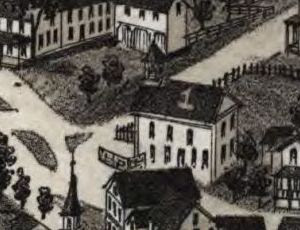


1. Congregational Church

The Second Congregational Church at 1 Middlefield Road in Chester. The exterior of the building remains much the same today as when the church was organized in 1844. Between that time and 1901, the church was served by over twenty successive ministers, the shortest pastoral term encompassing a mere two months and the longest around nine years. Half of the ministers spent one annum or less tending the Chester flock. The isolation and intensity of the harsh hill town winters probably had much to do with the high turnover rate of holy men, as well as the fact that many pastors preached a circuit, serving more than one area congregation at a time.


2. Methodist Church

Just east down Route 20 from the Second Congregational Church, the foundation of the Chester Methodist Church was laid in 1845, with construction complete and a formal dedication two years hence, in the autumn of 1847. A keg of gunpowder planted by those in opposition to members of the Methodist congregation's very active town temperance movement severely damaged the building when it exploded on the night of February 22, 1854. Repairs took months to complete, the church formally re-opening on August 6, 1854. The church ceased operating in that function in 1921, when members merged their flock with that of the Second Congregational Church. The structure was sold to the Samoset Lodge and then the Masons, and was shuttered in 1995.

The Chester Historical Society's, April, 2003, newsletter brings the Methodist Church building to life with a wonderful and comprehensive article detailing the structure's "storied past." Here's the link:

http://www.chestermass.com/Chester_Historical_Society/Newsletter/2003_April.pdf


3. Town Hall/Public School

The manufacturing and population growth explosion of the village of Chester Factories in the late Industrial-period resulted in the relocation of the town's civic offices there in 1870 from the original Chester Center, over 3 1/2 miles to the northeast. Chester's municipal building in 1885 combined civic and educational space. Today, the Chester Town Hall, at 15 Middlefield Road, (aside from being the place to take care of town business) is where the very talented and creative Chester Theatre Company holds its performances. The Chester Theatre Company is celebrating its 20th year in 2010 and is trying something new to raise production funds with its 1st Annual Winter Online Auction, to be held this March from the 21st to the 28th. To support this worthy cause, visit the Theatre Company's web site:

http://www.chestertheatre.org/index.cfm?CFID=2159403&CFTOKEN=23869293

And here's a link to the official Town of Chester web site:

http://www.townofchester.net/chestermass/


4. White's Hotel - W. R. White

Opened around 1882, William Roland White's hotel was virtually brand-new when Burleigh's map was created in 1885. Illustrated then in its 19th century location at the intersection of Depot and River Streets, today the building presides over the corner of Chester's Main and Riverfront Streets. Never physically moved, the former hotel's new address comes courtesy of a renaming of streets. The structure has been physically altered, though, with the later addition of a second-floor porch among other changes. Here are links to a couple of postcards of the hotel when it was known as the Riverside Inn from the late Shirley Bruso's excellent collection of Jacob's Ladder images:

http://homepages.rootsweb.ancestry.com/~shirleyb/jacobsladder/riverside2.html

http://homepages.rootsweb.ancestry.com/~shirleyb/jacobsladder/hotel2.html

This photograph, snapped by Francis Seddon in 2003, shows the Italianate-style beauty as it enters the 21st century:

http://homepages.rootsweb.ancestry.com/~shirleyb/jacobsladder/seddonhotel.html
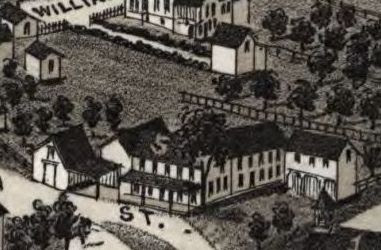


5. Chester House - W. H. Day

Within fifteen years of being drawn into map image immortality, William H. Day's Chester House, on the corner of Main Street and Middlefield Road, was razed to make way for a new school. Isaac Stevens was the first proprietor of the tavern, opening the doors to travelers in the early 1800s. The two and a half story, red-brick Chester Grammar School, which replaced Day's inn, has been a prominent landmark as one enters town since the dawn of the 20th century.


6. Hampden Emery Co. (Upper Mill)

The industrial abrasive, emery, was first detected after a visit to Chester on August 19, 1863, by Professor Charles T. Jackson, a Boston geologist who had been poking around for mineral samples in a mine owned by the Chester Iron Company. The mine had been worked unsuccessfully for a short span in the late 1850s after Dr. Heman S. Lucas's 1856 discovery of quantities of iron ore there and had restarted ore-extraction operations not long before Jackson revealed his findings to Lucas. Lucas confirmed the emery deposit several weeks later, the first major vein recorded in the United States.

Here's a link to a great article on Dr. Heman S. Lucas and the Chester emery trade by historian John Garvey, published in the May, 2006, newsletter of the Chester Historical Society:

http://www.chestermass.com/Chester_Historical_Society/Newsletter/2006_May.pdf

And here's a link to an 1865 article in Volume 89 of the American Journal of Science by Professor Jackson, describing the discovery of emery in Chester in his own words:

http://books.google.com/books?id=o_cQAAAAIAAJ&dq=charles%20jackson&pg=PA87#v=onepage&q=charles%20jackson&f=false


Hampden Upper Mill

It is a sign of the times that in 1885, mills and industrial enterprises - complete with belching smokestacks - would be featured as map insets. Development and progress were admired and encouraged in the late 19th century, the American dream being reshaped and reformulated in a nation transformed by upheaval, content to look forward (indeed, driven to) lest the bloody past of a country divided overtake a prosperous future.


6. Hampden Emery Co. (Lower Mill)

The 1863 discovery of emery in Chester brought its own form of abrasive personal and commercial upheavals. The Chester Iron Company was quickly reorganized as the Chester Emery Company, the principals being Dr. Heman S. Lucas, Henry D. Wilcox, James T. Ames and John E. Lucas, Heman's brother. Trying to squeeze iron out of rock was soon forgotten as profitability in the emery trade ensued. No longer dependent on importation of emery from Turkey or Greece, companies nationwide contracted with the Hilltown firm to provide them with the mineral, resulting in the rapid growth of the Chester Emery Company within the first few years of its incorporation.

By 1868, James Ames was overseer of the emery company and the Chester mines - gaining the top spot per vote of the board of directors - and Dr. Heman Lucas was out. The Hampden Emery Company was formed in all due haste, with Dr. Lucas, Henry Wilcox and Professor Jackson at the helm. The industrial rivals slugged it out in court over the next several years, each asserting rights to the mines with the Chester Emery company ultimately emerging the winner of the six-year skirmish.

The mills of the Hampden Emery Company managed to stay open after the court decision using ore imported from Turkey. Dr. Lucas, seeking other sources of the mineral, purchased land in North Carolina where emery had been located and, shortly after, began mining operations there, securing a steady supply of the industrial necessity for his factories back home before a year had run out on the legal setback his firm had suffered. The 1883 death of his former partner and competitor James Ames brought the deeds to the Chester emery mines back into the hands of Dr. Heman Lucas and the Hampden Emery Company, the rights to the properties purchased by the firm soon after Ames's passing. Lucas himself passed away in 1900. Around 1913, the Chester emery mines were closed.


Hampden Lower Mill

Dr. Heman Lucas's travails weren't limited to acts of man. The New York Times reported on July 14, 1874, that flooding in Chester had resulted in $10,000 worth of damage to one of the mills of the Hampden Emery Company. The Hannum Edge Tool Company - another concern of Lucas's - also sustained damage during the leveling display of nature's wrath. Many farms (including Lucas's fifty-acres) were affected by the raging waters, so powerful that Chester buildings were moved from their foundations and spun, left facing compass points anew. Four bridges were swept away and many roads were washed out in the deluge, which affected just about every resident in town. 1874 was a bad year for floods in Western Massachusetts, the Williamsburg reservoir dam on the Mill River in neighboring Hampshire County bursting under heavy rainfall two months earlier, on May 16, 1874, resulting in a loss of 139 downstream souls.

Here's a link to a previous EWM map post detailing an 1854 map of Hampshire County which, oddly enough, includes Chester Village although Chester had become part of Hampden County when that county was created from Hampshire County acreage on February 25, 1812:

http://explorewmass.blogspot.com/2009/07/map-hampshire-county-massachusetts-1854.html


7. Grant Corundum Wheel Co.

According to the Report of the Tax Commissioner of the Commonwealth of Massachusetts, published in 1889, grinding wheel manufacturer Grant Corundum Wheel Company, was certified an organization on November 14, 1882. Company owner Frank Grant's business, which had relocated to Chester around 1880 from Manchester, NH, was somewhat and unfortunately short-lived, burning to the ground in 1892.
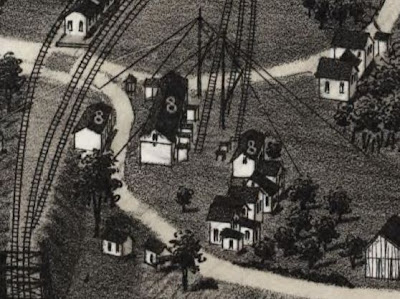


8. Chester Granite Works

Although it had to be hauled into town over three miles along the Chester & Becket Railroad from where it was quarried in Becket to be worked, the blue-hued granite of Becket became known as "Chester dark" and "Chester light" to geologists, a sample's classification determined by the amount of black mica tinging the stone. In 1885, granite quarrying, cutting and polishing was growing into an important industry in Chester, the fine-grained stone highly desirable for its monument-quality texture. Today, one can visit the Chester-Hudson Quarry at Becket and step back into the past, thanks to the hard work and dedication of the folks at the Becket Land Trust and those who contribute to their awesome endeavors. Here's a link for more information:

http://www.becketlandtrust.org/quarry/index.htm


9. James Keefe's Quartz Mill

Perched on the edge of Walker Brook, right upstream from where the West Branch of the Westfield River runs into it on the way to meet her two sister branches, Keefe's Quartz Mill was just one of several commercial concerns owned by the Keefe family of Chester. Quartz exists in abundance in the area, and when ground, finds its profitability in its use in the production of porcelain. James Keefe served with the 46th Massachusetts regiment during the Civil War, one of many Chester men who fought for the Union.


10. Chester Tannery

In 1885, tanning - making leather from animal skins - was the primary industry in Chester, the tannery along Walker Brook one of three processors in town. According to the 1982 Massachusetts Historical Commission's Reconnaissance Survey Town Report for Chester, thirty-percent of Hampden County's 1885 leather production originated from Chester tanneries. Here's a link to the Commission's Report:

http://www.sec.state.ma.us/MHC/mhcpdf/townreports/CT-Valley/cht.pdf


11. Chester Grist Mill

A grist mill was a vital part of every town before the days of packaged bread and preservatives. Chester Grist Mill harnessed the hydro-power of Walker Brook to grind grain to flour. The seasonal Bisbee Mill Museum in nearby Chesterfield (66 East St.) offers visitors a chance to see a refurbished early-1800s grist mill. The museum is open Sundays 2-5, from June to October. Here's some more information, courtesy of the Jacob's Ladder Business Association:

http://www.jlba.org/Tourism/bisbee_mill.html


12 McGeoch & Co.'s Bedstead Factory

Surrounded by heavily wooded forest and graced with a strong flow of running water, Chester visionaries and entrepreneurs took advantage of the opportunities afforded them, sawmills and comb factories, bedstead, bobbin, crib and furniture makers springing up along river and stream banks, water wheels churning out the future.


13. Smith's Carriage and Sleigh Manufactory

Smith is a surname long-associated with the Town of Chester. In the 1911 New England Historic Genealogical Society reference work, Vital Records of Chester, Massachusetts, to the Year 1850, there are over five pages of Smith births, three pages of marriages and a bit more than two pages of deaths.


7. Grant Corundum Wheel Co.
14. T. Keefe's Bedstead Factory

Timothy Keefe was an active citizen in Chester trade and civic affairs. In addition to owning the bedstead factory on Middlefield Road, Keefe was proprietor of a general store, which he later handed down to his son, James, owner of the Quartz Mill on Walker Brook. The store had initially been opened by partners William Shepard and Hiram Barber in the village of Chester Factories in the early 1800s . Timothy Keefe was town clerk from 1863 to 1871, and was also important to the village's public library, serving as trustee.

By 1904, Keefe's Bedstead Factory and the remnants of Grant Corundum Company had been replaced by the brand-new facilities of the Hamilton Emery Company, under the direction of company founder, Frank Hamilton. Here's a link to the Chester Historical Society's feature article commemorating the firm's 100th anniversary in the society's, March, 2005, newsletter:

http://www.chestermass.com/Chester_Historical_Society/Newsletter/2005_March.pdf


15. B. & A. Round House

On May 15, 1833, the Western Railroad Corporation was established and charged with extending the Boston & Worcester Railroad to Massachusetts' western border. In October of 1839 the first train arrived in Springfield from Worcester. By May 24, 1841, trains were running as far west as Chester Factories, bringing a new avenue of prosperity to the village. As the massive rail transportation project moved toward the New York border, Chester's importance grew to the line, becoming a certain stop so that pusher locomotives could be added to passing trains in order to assist them in surmounting the unforgiving grades around Gobble Mountain and Walnut Hill and westward to Washington and beyond. The workhorses of the Western railroad were stored in the round house, with a turntable guiding them into their respective resting places. The Western Railroad had been renamed the Boston & Albany Railroad by the time L. R. Burleigh's map was produced in 1885. A view from Google Earth shows the dirt circle tracing of the turntable and remnants of the round house still in place.


16. B. & A. R. R. Station

The Boston & Albany Railroad Station in Chester, though never reborn with the grand architecture of others along the line, was a welcome sight before the days of dining cars, many a hungry wayfarer disembarking an ever-swaying carriage into the warm glow of the eatery located there while the yardmen went about the business of coal and water amidst the pulses of steam and the clanging of bells, the explosive clash of locomotives connecting for the climb ahead purposeful and true. Today the station is lovingly maintained by the Chester Foundation and is open for visits seasonally, by appointment or during special events. For some incredible photographs and history and more information about making a trip out to the tracks, visit the Chester Railway Station web site:

http://www.chesterrailwaystation.org/


17. Post Office

One can read books, scan reports and peruse old newspaper articles for weeks and still never know as much about a town as you would if you were a fly perched on the wall of the local Post Office for the day.


18. Skating Rink

After all of the granite-quarrying and emery-bonding and shepherding and leather-making. After all of the grain was milled and bedsteads were made and tables were waited. After the stores closed and the quartz was ground, the good folks of Chester were able to unwind at the skating rink, to strap wheels to their soles and roll away the night in spinning social circles of small town Western Massachusetts. One can't help but feel that the people who sprung from and worked this hard, rocky soil deserved every moment of joy they could find in 1885.

As always, thanks for stopping by and take care.

* * *

For more maps - modern and historic - visit the EWM page, Trails, Rails & Roads: Western Mass. Maps. For best results viewing the above map and others at EWM, save images and view in a photo program with a zoom feature.


Map Source: Library of Congress; American Memory; Map Collections; Troy, N.Y.: L.R. Burleigh, [1885] (Milwaukee, Wis. : Beck & Pauli, litho); Digital ID: g3764c pm010820 http://hdl.loc.gov/loc.gmd/g3764c.pm010820


Home|Welcome|Table of Contents|Explore|Upcoming Events|Patrons|Marketplace|Contact|Privacy